Posts

Rereading the Nineties
Image
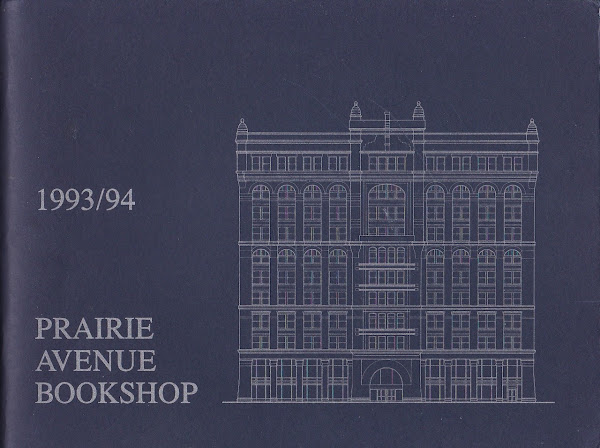
Some of the references consulted during the research phase of my 2021 book Buildings in Print: 100 Influential & Inspiring Illustrated Architecture Books , but not mentioned in the book's "selected bibliography," were old catalogs from the Prairie Avenue Bookshop, the beloved and still sorely missed architecture bookstore that first opened, appropriately, on Prairie Avenue on Chicago's Near South Side in 1974 and closed in 2009 in a grand two-story space on Wabash Avenue across from Louis Sullivan's Auditorium Building. In between, the bookshop was located on South Dearborn Street in — again, appropriately enough — Printer's Row, when, according to the bookstore's own website ( browsable via Wayback Machine ), "the catalog for the bookshop grew into a tour de force of architectural bibliography , ultimately becoming the intellectual touchstone for professional architects and interested laypeople throughout the world" (my emphasis). Those in-b...

On Awards

Image
When Arata Isozaki died at the end of 2022 at the age of 91, nearly all of the news stories and obituaries mentioned that he was a Pritzker Architecture Prize laureate, and  quite a few  also included mention of the Pritzker Prize in the headline. Although the Pritzker has long been likened to the Nobel Prize, the importance of "architecture's Nobel" in coverage of stories involving their laureates also puts it on par with the Academy Awards. "Oscar-winning" is a common phrase in an obituary or other headline involving an actor, director, or producer who won an Academy Award at one point in their life. Mention of Pritzker, Oscar, Nobel, or other prestigious prizes signals to readers not so well versed in architecture/Hollywood/science/etc. that the subject of the story is/was important in their field, just as it elevates the prize within the field, indicating that it is the highest honor that person could garner. Awards like the Pritzker also serve to structur...

From Web to Print

Image
Recently I was watching a news program, most likely PBS Newshour or an MSNBC show, and was struck by one of the talking heads speaking via Skype or Zoom being described as "a writer working on turning her blog into a book." I don't remember her name or even the subject, as the news story was not one I was interested in, but this factoid stayed with me for a couple of reasons: I'm a blogger, and I have a hard time envisioning this blog, the one I'm most familiar with, making the leap into book form. Blogs are personal creations, so they vary widely, even as their formats — based as they are on Blogger, WordPress and other systems — are fairly consistent, with chronological posts made up of of words and images.  I could see some writers tailoring their blogs to potential books, with posts written as chapters or posts combined to become chapters in a book, but for me the blog — both generally and mine specifically — is an informal means of sharing ideas and viewpoint...

On Guidebooks

Image
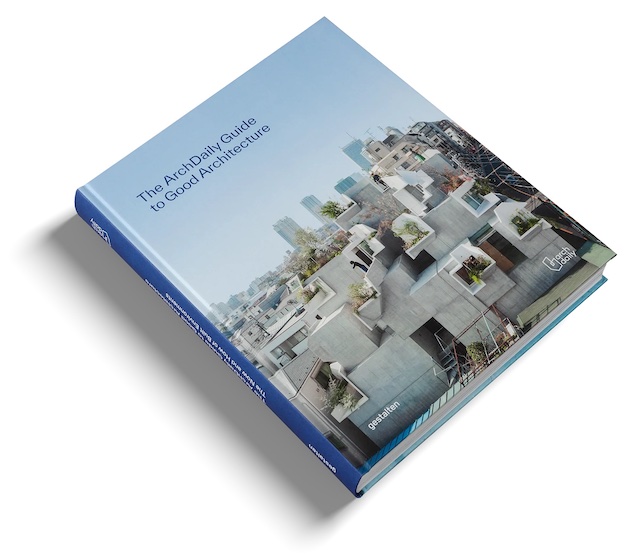
A portion of the paperback wrapper of A Guide to the Architecture of Washington, D.C. , published by the Washington Metropolitan Chapter of the American Institute of Architects in 1965.   Are guidebooks still a valid and useful subgenre of architecture books? Do architects consult them when they visit a city? Do they walk around neighborhoods with them? Do publishers therefore still feel the need to put them out? The two titles featured in this post attest that they are still being published, but there certainly aren't as many coming out now as in the past. The days of the Pevsner guides and G.E. Kidder Smith volumes — when a single author or small team could spend years researching and documenting the architecture of a city or even a country — are long gone. Furthermore, I have a hard time seeing guidebooks produced this century being reissued decades from now, akin to Ian Nairn's books on London and Paris  (though I haven't seen any of them, Owen Hatherley's alternat...

This Blog in 2023

One year ago, in the first post of 2022 , I shifted this blog from (almost) daily posts about architecture books to just once a week, changing the name of the blog to reflect that. In the fifth of five bullet points reasoning why that was happening, I wrote: "I'm planning on winding down this blog over the next two years, wrapping it up in January 2024... exactly 25 years after I started A Weekly Dose of Architecture," the first iteration of this occasionally shifting blog. I'm still on track to do that, but with just one year of posts left — or 50 of them, if I don't skip too many weeks — I figured it's a good time to steer from the formulaic reviews and "Book Briefs" and instead write posts that are about architecture books but are not strictly reviews or encapsulations of them. So look for posts that are "On" certain typologies of architecture books or about issues around them: "On Guidebooks," next week for instance, as well ...

Favorite Books of 2022

Image
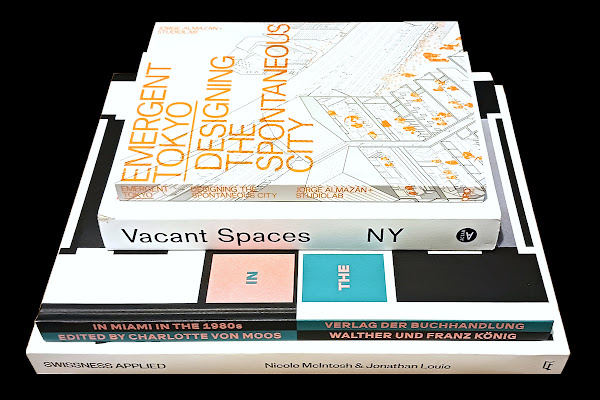
For this last post of 2022 I looked back at the dozens of books I reviewed or featured as "Book Briefs" on this blog, and the ones I reviewed on World-Architects. From those books I gathered just over a dozen favorites, grouping them into some common themes that happened to come to the fore: places, architects, and books/writers; they are listed below with brief commentary and links to my original reviews. Although these are my favorite books from 2022, not all of them were published this year (I'm often slow at getting around to books so I don't always follow the annual spring/fall cycle of publishers). As such, I've listed at bottom some recent and forthcoming books I'm looking forward to reading and (hopefully) reviewing in the new year. Until then, warm holiday wishes!  4 Books on 4 Places: Emergent Tokyo: Designing the Spontaneous City  by Jorge Almazán + Studiolab, published by ORO Editions (2022)  — A beautifully illustrated analysis of various "sp...

Book Briefs #48

Image
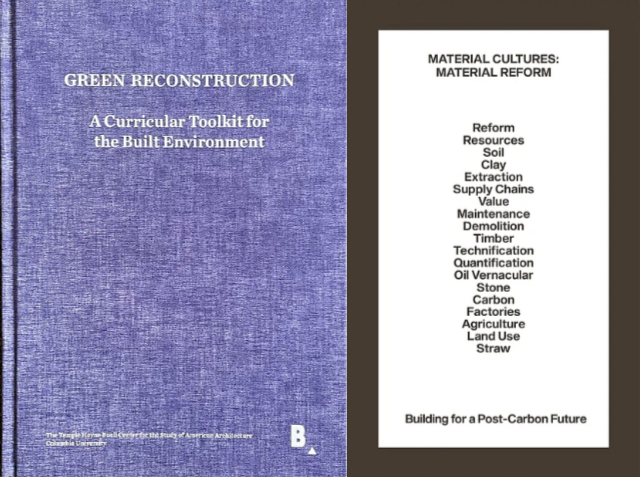
This latest installment of  "Book Briefs"  — the series of occasional posts featuring short first-hand descriptions of some of the numerous books that publishers send to me for consideration on this blog — features six books in three pairs. Obviously, these briefs are not full-blown reviews, but they are a way to share more books worthy of attention than those that end up as long reviews. Two "Green" Books: Green Reconstruction: A Curricular Toolkit for the Built Environment  edited by Reinhold Martin, Jacob R. Moore, Jordan Steingard | Temple Hoyne Buell Center for the Study of American Architecture | September 2022 | 7-1/4 x 10-1/2 inches | 266 pages | $0 ( available as a PDF ) The Buell Center describes Green Reconstruction  as "an outline, an open work, for the repair of a world ravaged by three intersecting crises — of mutual care, of racial oppression, and of climate, all intersecting in turn with economic inequality." As the subtitle of the book mak...