Posts

Showing posts from September, 2023

42 Years of Critical Regionalism
Image
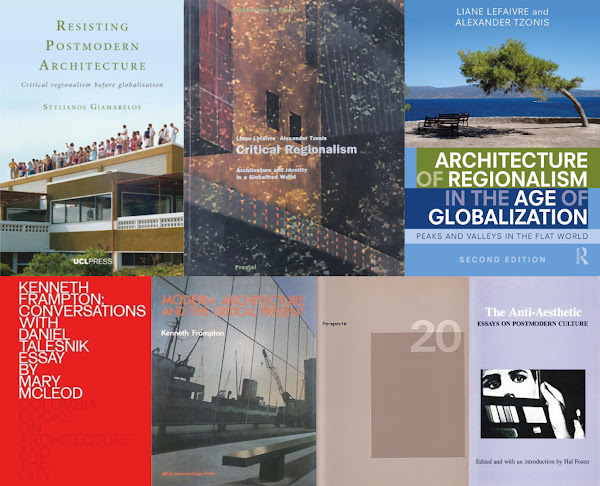
(Covers of some of the books discussed in this post) If your first reaction to the title of this post is something along the lines of, "Wait, isn't critical regionalism just 40 years old?," then everything you think know about critical regionalism is partial, in both senses of the term: incomplete and biased. Yes, Kenneth Frampton's "Towards a Critical Regionalism: Six Points for an Architecture of Resistance" was published in Hal Foster's The Anti-Aesthetic: Essays on Postmodern Culture  in 1983, exactly 40 years ago, but the term "critical regionalism" was coined two years earlier by Alexander Tzonis and Liane Lefaivre in their article "The Grid and the Pathway: An Introduction to the Work of Dimitris and Susana Antonakakis" in Architecture in Greece . But as the term took hold in architectural circles that decade, and to a lesser but still lasting degree in the decades since, it has more often been associated with Frampton's es...

The Latest from MoMA: Emerging Ecologies

Image
Like many people with a lot of books, I keep track of my library with an app/website, tagging books with keywords to better filter and find them. The tags I use move from general terms like "architecture" (the most) and "fiction" (the least) to specific terms that reflect a high number of books by a particular author ("frampton," as in Kenneth) or maybe about a certain architect ("wright," Frank Lloyd). One of the oft-used tags on the specific end of the spectrum is "moma," which includes books published by the Museum of Modern Art, be it Robert Venturi's Complexity and Contradiction in Architecture or exhibition catalogs, as well as books actually about MoMA, like Terence Riley's The International Style: Exhibition 15 and The Museum of Modern Art . As of today, I have 34 books tagged "moma" in my library, spanning from  The International Style in 1932 ( the 1990s reprint , mind you, not the first edition ) to  Emerg...

Places in Time II

Image
Last week dose explored three  "places in time" : St. Louis in the early decades of the 20th century; Detroit between 1935 and 1985; and Chicago suburb Oak Park ca. 1906, when Frank Lloyd Wright completed Unity Temple. Those three US-centric books were split between two historical surveys and one case study.  The same applies to the European/Asian books here, with a survey of brutalist architecture in Paris followed by a survey of Indonesian architecture trained in Germany around 1960 and a case study of a care center for people with mental disabilities in Belgium. Brutalist Paris: Post-War Brutalist Architecture in Paris and Environs  by Nigel Green and Robin Wilson, published by  Blue Crow Media , July 2023 ( Amazon  /  Bookshop ) Dipl.-Ing. Arsitek: German-trained Indonesian Architects from the 1960s  edited by Moritz Henning and Eduard Kögel, published by  DOM Publishers , July 2023 ( Amazon  /  Bookshop ) Living in Monnikenheide: Ca...

Places in Time I

Image
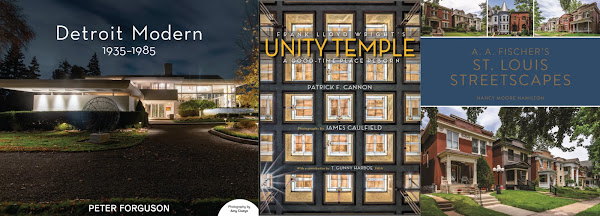
Like most human beings, I can be contradictory at times. One area where this manifests is architectural surveys: books that usually collect buildings of a certain typology, but also ones spanning a particular timeframe or through some other theme. I've written a few of them myself , so I don't inherently hate them. But I tend to pass on them when it comes to new books, which most likely boils down to the fact I'm not a practicing architect and therefore don't need to look at, say, a roundup of libraries when I'm designing one. Yet, when it comes to old surveys — as in my latest #archidosereads — I have a hard time saying no to them after spotting them in used bookstores. I think part of their appeal is the way they capture the character of a certain time, and often, with the occasional geographical focus of surveys, a particular place in time. Being seen decades after they were made, the best ones manage to transport me back to a certain place in time — something I...