Posts

Showing posts from April, 2018

Today's archidose #1001

Image
Here are some photos of Summer House in Tisvildeleje, Denmark, by Gehrdt Bornebusch. (Photographs: Flemming Ibsen , who has more in photos of the architect's buildings in his Flickr set .) To contribute your Flickr images for consideration, just: :: Join and add photos to the  archidose pool To contribute your Instagram images for consideration, just: :: Tag your photos  #archidose

Book Review: Las Torres De Ciudad Satélite

Image
Las Torres de Ciudad Satélite by Fernando González Gortázar, published by  Arquine , 2014. Paperback, 176 pages. ( Amazon ) I picked up this book in June 2016 after coming across it in a bookstore, but I didn't actually read it until this week. The reason I pulled it off the bookshelf was a screening of Jill Magid's The Proposal , a documentary film focused on the Brooklyn artist's obsessions with Mexican architect Luis Barragán, the holding of his professional archive in Switzerland, and Magid's attempt (the proposal of the film's title) to get the archive returned to Mexico. I have other books on Barragán, but I read this one before and after seeing the film since Federica Zanco, the wife of Vitra chairman Rolf Fehlbaum and the caretaker of the archive, wrote the lengthy Foreword to the book, a historical case study of one of Barragán's most unique and exceptional projects: the Torres de Satélite , entry markers to a large development north of Mexico City...

Curious Minds

Image
Seeing this photos of  MUMA Architects' community center in Cambridge, England, via today's Dezeen Daily... [Photo: Alan Williams] ...I couldn't help think of this photo of Antoine Predock's  Ventana Vista Elementary School in Tucson, Arizona: [Photo: Timothy Hursley (I think)] Uniting the two are the small, low apertures that enable children to peer through them, instances captured by both photographers. With that, I decided to look around for similar images, finding the ones below. My point here is that it behooves architects designing early education buildings to cater apertures to curious minds, not just furniture and fixtures. These examples show that many architects are already doing just that. New Building for Nursery and Kindergarten in Zaldibar by Hiribarren-Gonzalez + Estudio Urgari: [Photo: Egoin] El Guadual Children Center by Daniel Joseph Feldman Mowerman and Iván Dario Quiñones Sanchez: [Photo: Ivan Dario Quiñones Sanchez ] Guardería ...

Old+New Book Review: Paul Shepheard

Image
What Is Architecture? An Essay on Landscapes, Buildings, and Machines by Paul Shepheard, published by  MIT Press , 1994. Paperback, 132 pages. ( Amazon ) Buildings: Between Living Time and Rocky Space by Paul Shepheard, published by  Circa Press , 2016. Hardcover, 180 pages. ( Amazon ) "There is a scale of things all to do with the land , at on end of which are the forces of nature, the perception of which, at any given place, I would call landscape . At the other end of the scale are the local difficulties solved, and the opportunities opened, by our use of machines — and somewhere in between are the buildings, which, if conceived grandly and accurately enough, can extend outward to embrace each end of the scale. Landscapes, buildings, and machines." This quote falls on page 41 of What Is Architecture? and it serves as a decent encapsulation of the three subjects Paul Shepheard tackles in the popular book. The book came out in 1994, when I was in the middl...

Of Architecture and Pelicans

Image
Somehow, in the course of reading email, checking Twitter and doing other things on the computer when I got to work this morning, I got off on the tangent of looking at covers of architecture books — specifically those produced by Pelican in the 1950s and 60s. The small paperbacks, of which I have a two or three, are visually appealing. In turn, the designs of the covers have been compiled on websites  and make up many a Pinterest and Flickr board. But most of the attention focuses fittingly on the graphic design rather than the content of the books. Accordingly, Pelican architecture books were scattered here and there. That's when I decided to find some (though far from all) of the Pelican architecture and urbanism titles, put them together in a grid, and see how they relate to each other. Doing that, I present this grid of 18 books without comment, only to say that some of the covers (namely  Georgian London and London: The Unique City ) had to be cropped to fit the g...

Building Tall in Manhattan, eVolo Style

Image
While four honorable mentions in the eVolo 2018 Skyscraper Competition are focused on Manhattan, only one comes close to approaching a traditional skyscraper. The others, like the first place winner in 2016 that proposed a horizontal skyscraper around Central Park, take a more liberal approach to designing "skyscrapers." Additive Effect: 3D-printed Skyscrapers : These skyscrapers littering Manhattan would be built by everybody's favorite 21st-century technology: 3D printing. At such a scale, the towers would take time to "print," so they take on a striated appearance. Yet instead of housing apartments or offices, the skyscrapers would serve as factories for creating cartridges for 3D printing from waste, part of which would be used for the factories' skins. In other words, the towers express what they do — and apparently illustrate a future where just about everything is printed and therefore requires such factories. Manhattan Ridge: Affordable Housi...

Book Briefs #35: Better Late Than Never

Image
"Book Briefs" are an ongoing series of posts with two- or three-sentence first-hand descriptions of some of the numerous books that make their way into my library. These briefs are not full-blown reviews, but they are a way to share more books worthy of attention than can find their way into  reviews on this blog . This installment features books I received years ago but never got around to posting about — until now. African Modernism: The Architecture of Independence. Ghana, Senegal, Côte d'Ivoire, Kenya, Zambia  edited by Manuel Herz | Park Books | 2015 |  Amazon Although the size of a coffee table book and graced by full-page Iwan Baan photographs, African Modernism  is a deep, scholarly work, not just something to flip through. Focused on the five subtitled African countries that gained their independence in the late 1950s and early 1960s (5 of 32 countries on the continent that did so), the book examines how architecture played a role in expressing the...

A305 Complete

Image
The Canadian Centre for Architecture has just wrapped up posting the series A305, aka "History of Architecture and Design 1890-1939," on its YouTube channel. The 24 programs created by the Open University originally aired on BBC2 between 1975 and 1982. The CCA uploaded them as part of its exhibition, The University Is Now on Air: Broadcasting Modern Architecture , which was on display until the beginning of April. Head to my A305 post from January to watch all 24 episodes.

#TBT to NWA

Image
Last summer I visited Crystal Bridges of American Art in Bentonville, in Northwest Arkansas, but I didn't get around to processing my photographs until this month. An unexpected gem from the visit was the welcome pavilion for Frank Lloyd Wright's Bachman-Wilson House , designed by students at the Fay Jones School of Architecture + Design. Below are my photos and a video by the University of Arkansas.

Are You the Next Eva?

Image
Recently the Storefront for Art and Architecture's Executive Director and Chief Curator Eva Franch i Gilabert was appointed Director of the Architectural Association in London. Her new position means the Storefront needs a new director — its fifth director following Franch, Joseph Grima, Sarah Herda, and co-founders Kyong Park and Shirin Neshat. Franch took her position at Storefront in 2010 and in the ensuing eight years she oversaw a staggering number of exhibitions, publications, and other projects, including the OfficeUS , the US Pavilion at the 2014 Venice Architecture Biennale. Her last undertaking at Storefront will be the New York Architecture Book Fair , set to take place in June. The job posting from storefrontnews.org : Storefront for Art and Architecture is seeking a Director who is an ambitious visionary, a curatorial risk-taker, and a dynamic leader, and who will continue and expand Storefront’s position as an innovative and fearless platform for debate and e...

Book Review: The Arsenal of Exclusion & Inclusion

Image
The Arsenal of Exclusion & Inclusion by Interboro Partners (Tobias Armborst, Daniel D’Oca, Georgeen Theodore), published by  Actar , 2017. Hardcover, 460 pages. ( Amazon ) Back in 2011, Interboro Partners won MoMA PS1's Young Architects Program, installing "Holding Pattern" in the courtyard of the Long Island City, Queens, institution that summer. Although seven years old, the installation comes to mind when reviewing their new book,  The Arsenal of Exclusion & Inclusion , for a few reasons: It was the first I'd heard of Brooklyn's Interoboro; "Holding Pattern" was accompanied by a mural designed by Lesser Gonzalez to visually explain the installation's concept, a diagram very similar to the one he made for the book's cover and accompanying foldout poster; and although the installation's most striking feature was the "soaring hyperboloid" of fabric over the courtyard, its most lasting impact came from the furnishings...

Mies, Sitting and Smoking

Image
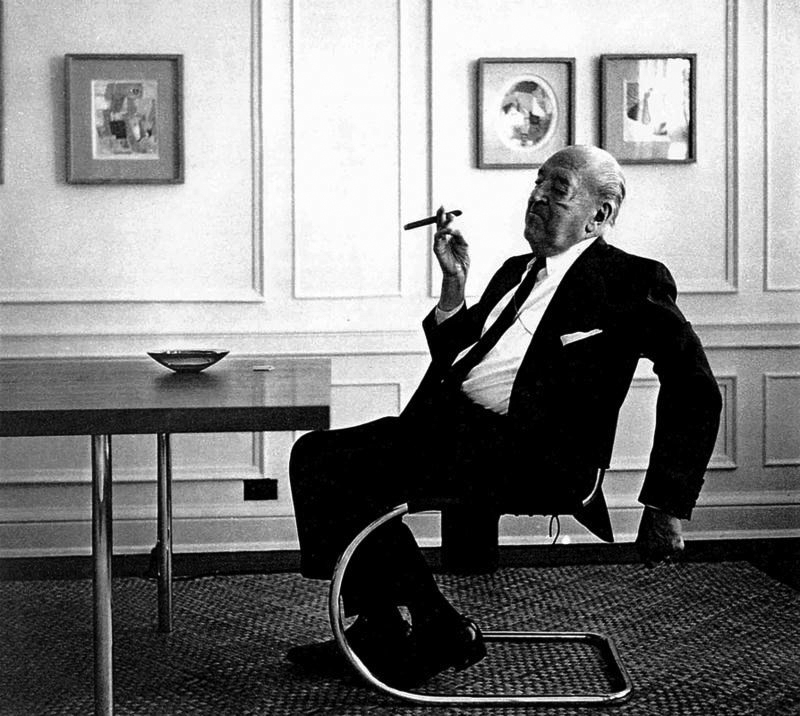
Every architect knows this famous photo of a famous architect: [Mies in his Chicago apartment, 1964, photographed by Werner Blaser] Lately I've noticed this figure of Ludwig Mies van der Rohe collaged into architectural renderings. A case in point: [Art Academy Heist-op-den-Berg by Compagnie O. Architects] Images like this are enabled by Photoshop and easy-to-find cutout images such as this PNG with an invisible background: [ Cutouts of Famous Architects at 3NTA ] Not surprisingly, images incorporating Mies sitting and smoking on his MR10 Chair pay homage to Mies: [Source unknown] Likewise, this one depicts Mies in his Neue Nationalgalerie in Berlin and swaps out the MR10 for a Barcelona Chair: [Image by Aaron Bass from Maxwell Render Challenge 20 Finalists ] But other renderings displace Mies into an unexpected setting, such as this gem by Norman Kelley: [ Aesop Lincoln Park by Norman Kelley ] Know of more? Comment or email me and I'll add them to this...

On Arakawa + Gins

Image
Last Friday, Columbia GSAPP opened Arakawa and Madeline Gins: Eternal Gradient at the Arthur Ross Gallery, the same day it convened a conference — Encounters with Arakawa and Gins — on the collaboration of Arakawa (1936-2010) and Madeline Gins (1941-2014). If architects know of the pair, it is because of such architectural works as  Site of Reversible Destiny – Yoro , Reversible Destiny Lofts , and Bioscleave House  rather than their earlier artworks or literature. How a conceptual artist and poet/philosopher (Arakawa and Gins, respectively) ventured into architecture and the production of buildings and landscapes is the subject of Eternal Gradient . Before delving into the gallery, a few words on how I came across the pair's work. It was in undergraduate architecture school in the early 1990s when I obtained the AD monograph Architecture: Sites of Reversible Destiny (Architectural Experiments After Auschwitz-Hiroshima) . Published in 1994, the book is filled with comput...

Book Briefs #34

Image
"Book Briefs" are an ongoing series of posts with two- or three-sentence first-hand descriptions of some of the numerous books that make their way into my library. These briefs are not full-blown reviews, but they are a way to share more books worthy of attention than can find their way into  reviews on this blog . Embodied Energy and Design: Making Architecture between Metrics and Narratives  edited by David Benjamin | Columbia University GSAPP, Lars Müller Publishers | 2017 |  Amazon In April 2016, Columbia GSAPP held the Embodied Energy and Design symposium , which aimed to frame embodied energy "in the context of broader design ecosystems and architectural issues." This book collects the papers from that symposium, interspersing them with "material stories" that illustrate the questions architects should be asking about the sources, energy, and production of their buildings, focusing on concrete, steel, and wood. As energy use in the operation of...

MIMOA 2.0

Image
If you're like me, when you travel you consult MIMOA , the user-generated website that functions as a guide to modern architecture. The website is particularly helpful with registration, which enables adding projects but also favoriting them, marking them as visited, and creating guides for particular cities or routes. For example, here is a guide I made for a trip in August 2012 , going from Zurich to Venice. If you're really  like me, you also find the MIMOA page frustrating to use on mobile platforms. It's very good on a laptop, but since it's not mobile-friendly I don't even bother on a smartphone. The team at MIMOA is aware of this and trying to do something about it. The current MIMOA homepage: [Images courtesy of MIMOA Kickstarter campaign ] So what are they doing — more accurately, what are they trying  to do? MIMOA 2.0 , which will focus on two things: "A mobile-first redesign of the platform that will optimize the user experience and will prov...