Posts

Showing posts from September, 2011

Salter Directions

Image
This is just a note to let people know that over at The Archi-Tourist I have added directions to a couple Peter Salter buildings in Japan, both of which have been featured on my weekly page. Over the years I've received a bunch of requests on how to find especially the Mountain Pavilion near Kamiichi, in Toyama Prefecture, so I gathered my materials and responses and made a couple entries: Mountain Pavilion : Inami Woodcarving Museum :

NYC Guide Sneak Peek

Image
While it's not hitting store/online shelves until December 5th, a couple days ago I picked up an advance copy of my book -- Guide to Contemporary New York City Architecture -- from the publisher, W. W. Norton . Excited doesn't even begin to describe how I feel! Below is a sneak peek of the book. Soon I'll have a contest/giveaway for free copies of the book, so be sure to check back here for that. [The Austrian Cultural Forum New York graces the cover.] [An overall map keys the 22 chapters across all five boroughs.] [Each borough is introduced with a full-page photo and is further broken down into neighborhoods that feature dictionary-like numbering for easy browsing.] [Each neighborhood chapter starts with a full-page map and a description of the neighborhood.] [The main entries range from a half-page to two pages, most being one page; they all include photo(s), description, subway directions, and of course the name of the building and architect(s).] [A n...

Today's archidose #527

Image
Here are a few photos of Habitacle #2 in Meudon, France by André Bloc, 1964. Photographs are by Sipane . To contribute your Flickr images for consideration, just: :: Join and add photos to the archidose pool , and/or :: Tag your photos archidose

Book Review: Living in the Endless City

Image
Living in the Endless City edited by Ricky Burdett and Deyan Sudjic, published by  Phaidon , 2011. Hardcover, 512 pages. ( Amazon ) For those who digested 2008's The Endless City -- a product of the Urban Age conferences organized by the London School of Economics and the Deutsche Bank's Alfred Herrhausen Society -- this follow-up will tread familiar territory. The cover of Living in the Endless City even extends the data mining of the first book, yet this time around it opts for a visual approach over merely numbers (the center of each cover actually says exactly the same thing, one numerically, one graphically; to me the latter approach sinks in harder). Nine cities were the subject of the Urban Age conferences and six were collected in the 2008 tome; this book, almost as big, features the other three cities -- Mumbai, Istanbul, São Paulo -- alongside a lengthy introduction, lots of data, and "reflections" by conference participants, most acade...
Image
Grover Residence in Austin, Texas by Universal Joint Design, 2011. Photographs are by Patrick Y. Wong, courtesy Universal Joint. Elsewhere I've documented residential architecture that incorporates cantilevered upper floors, a rarity, even within the realm of modern/contemporary architecture. Cantilevers are expensive (extra structure, cladding, insulation, etc.) and formally extravagant, but this does not mean that one cannot be an appropriate solution for a family's home. In  many cases they can be rationalized towards reclaiming the space underneath, typically a part of the landscape, and for providing views that otherwise may not be possible. The Grover Residence by design-build firm Universal Joint Design is basically two rectangular boxes -- one sitting on the ground and the other one lifted ten feet in the air and cantilevered twenty feet beyond the first. This T-shaped diagram accomplishes a number of things: it creates a carport under the cantilever, a...

Book Review: The Glass House

Image
The Glass House by The National Trust for Historic Preservation, published by  Rizzoli , 2011. Hardcover, 80 pages. ( Amazon ) In 1986 Philip Johnson donated his New Canaan, Connecticut estate to the National Trust for Historic Preservation . It opened to the public in 2007, two years after the death of Johnson (at 98, just shy of his 99th birthday) and his companion David Whitney (who died six months later, at the age of 66). Referred to now in its entirety as The Glass House , the "campus" includes ten structures designed by Johnson and built between 1949 and 1995. This slim guide put out by Rizzoli, an update to the one published by Assouline in 2008 , visually documents these and other parts of the property, which can be visited annually from May to November. At only 80 pages, the book is hardly an in-depth look at the duo and their estate, but it does a good job of giving some order to Johnson's six-decade exploration of architecture. This happens via a site p...

Learning From the Weekender

Image
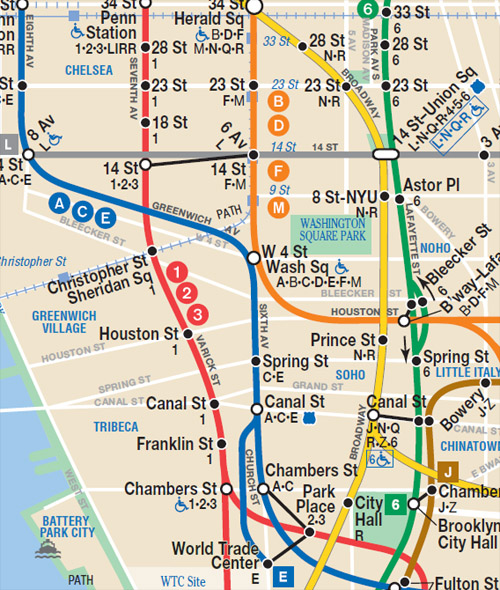
Many people are familiar with the current MTA Subway Map (PDF link) designed by Michael Hertz Associates in 1979 with modifications in 2010: But fewer people are probably familiar with the subway map designed by Massimo Vignelli in 1972 (a redesign of a map by George Salomon) , used by the MTA until its successor seven years later. More people should be seeing Vignelli 's design with the MTA's use of an updated version (from 2008/10, with Beatriz Cifuentes and Yoshi Waterhouse)  for The Weekender , which graphically describes the system's weekend construction: As can be seen in quick comparison of the two maps, Vignelli treats each line as its own conduit, rather than lumping each numbered or lettered line with its respective single-line color. This makes it suitable for The Weekender, so then each line can be shown if it is running or not over the weekend (in the above excerpt the B and M lines for example, are faded to indicate they don't run), and blinking dots ...

Half Dose #95: Zipper Bench

Image
[Photos and drawings are courtesy WXY Studio.] UNStudio's New Amsterdam Plein and Pavilion is a project born of good intentions -- a gift from The Netherlands to New York in celebration of the 400th anniversary of Henry Hudson's arrival in New York Harbor -- but with a reality less than ideal -- it was completed two years after the anniversary and the festivities. As well, the plein (Dutch for platform) was to receive UNStudio-designed seating, a complement to their flowing, flower-shaped pavilion. Instead the cafe is served by off-the-shelf (if high-design) tables and chairs. Enter WXY Studio and their Zipper Bench , installed around the plein and pavilion. The name Zipper Bench is appropriate, given that the long furniture splits around trees to do double duty: provide seating and protect the (in this case newly planted) trees. One can easily imagine the above bench and its tightly spaced slats as an actual zipper. Not all of the benches are "unzipped....

Today's archidose #526

Image
Here are some shots of the Pierre Vives building under construction in Montpellier, France by Zaha Hadid Architects . For some reason the project -- it serves the Hérault Department and includes archives, library, and sports department -- is nowhere to be found on her firm's new web page. Pierre Vives was featured on this blog previously, in a 2006 post on the state of starchitecture . Photographs are by Manuel.A.69 . To contribute your Flickr images for consideration, just: :: Join and add photos to the archidose pool , and/or :: Tag your photos archidose

Firm Faces #17

Image
'Tis the season for returning to school and therefore the DOE Solar Decathlon , coming after a summer of die-hard construction. This year's event (the Decathlon is held every two years) is located at the National Mall’s West Potomac Park, after a snafu earlier this year resulted in it being moved from its position between the Capitol and the Washington Monument. For those who can't make it to Washington, DC between Friday and October 2nd to see the student-built solar houses on display, the DOE's website has a decent roundup of the international teams . Included in each school's project description is a team photo, hence this post being lumped into my Firm Faces series . Since I'm a person like any, biased by his past, here I'm featuring the City College of New York team , whose entry is called Solar Roofpod : [City College of New York DOE Solar Decathlon Team | image source ] I must admit it's an interesting way of presenting the students and teac...

Jeanne Gang, 2011 MacArthur Fellow

Image
Congratulations to Jeanne Gang on being named one of the 22 MacArthur Fellows for 2011. Update: For reference, previous fellows in the field of architecture are: » Elizabeth Diller and Ricardo Scofidio in 1999 » Samuel Mockbee in 2000 » James Carpenter in 2004 In the various fields that the MacArthur Foundation recognizes, architecture is easily one of the smallest in terms of number of fellows.

Carving Manhattan

Image
As seen in The Architect's Newspaper , Yutaka Sone's carved marble model of Manhattan on display at David Zwirner gallery in Chelsea...: [Marble model of Manhattan by Yutaka Sone | image source ] ...is reminiscent of John Stoney's " Cross Section of the North American Continental Plate " from 2006 (I saw it exhibited at Caren Golden Fine Art in 2007 ), made from a 1-inch thick plank of pine above a 5-foot-tall base of polymerized gypsum: [Cross Section of the North American Continental Plate (2000-06) by John Stoney | image source ] Sone's marble model is about twice as long in plan as Stoney's wood model (approx. 21 x 104 x 33" versus 21 x 65 x 67"), but each artist chose carving as their means of expressing the same subject. Besides the unique appearance of each sculpture, owing to the different materials, the biggest difference might be the respective absence and presence of the Twin Towers in Sone and Stoney's impressive accomp...

Book Review: Beyond Shelter and Testify!

Image
Beyond Shelter: Architecture and Human Dignity edited by Marie J. Aquilino, published by  Metropolis Books , 2011. Paperback, 304 pages. ( Amazon ) Testify!: The Consequences of Architecture edited by Lukas Feireiss, published by  NAi Publishers , 2011. Paperback, 240 pages. ( Amazon ) One consequence of trends is that their popularity begets a renewed interest in their opposite or the things they displace. The current trend of digitizing just about everything shows signs of appreciating, among many other things, well-crafted books, handwritten letters and, in the realm of architecture, hand drawings and models built by hand. While these things still pale in comparison, in terms of attention and quantity, to their digital counterparts (ebooks, emails/texts, digital renderings), the important thing is that they are not displaced; they retain their potential as important means of thought and expression. In physical buildings this trend/opposite trait...