Posts

Showing posts from April, 2022

At the 2022 Book Fair

Image
Yesterday the New York International Antiquarian Book Fair opened to the public, the first of its four days at the Park Avenue Armory on Manhattan's Upper East Side. I was able tp attend the preview yesterday, taking the opportunity to search out items relevant to architecture. So,  like I did with the first fair I attended two years ago (it was the last event I attended before lockdown and was the most recent edition of the fair, it being cancelled last year), below are some of those finds — 15 items from 12 booksellers — with photos and captions, and listed in the order I discovered them. People interested in attending the 62nd Annual ABAA New York International Antiquarian Book Fair can buy tickets online . Located near the entrance, the booth for New York's Ursus Rare Books has a reduced version (still nearly 6' long) of the Historical Table for 'The Functional City'  exhibition ( De Functionele Stad ) at the Stedelijk Museum in 1935. It's attributed to R...
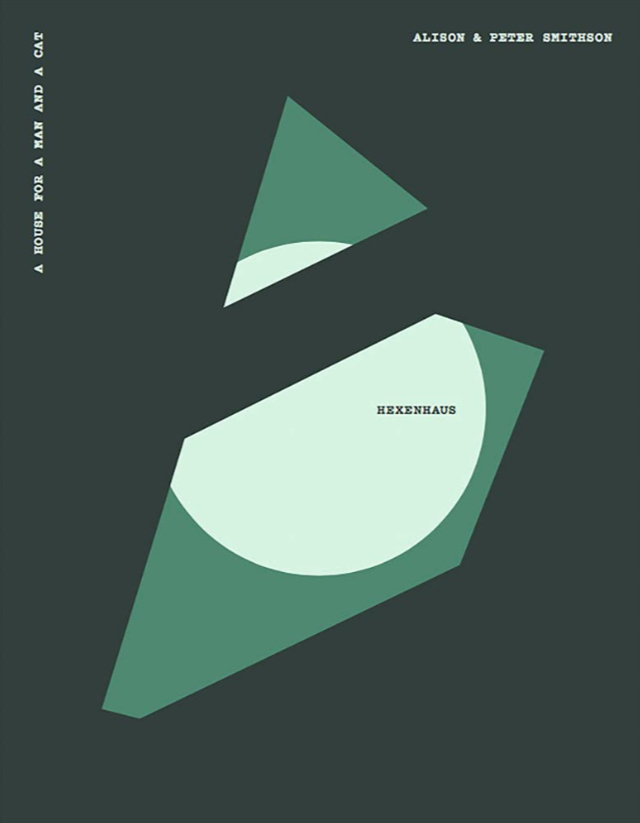
Alison & Peter Smithson: Hexenhaus

Image
Alison & Peter Smithson: Hexenhaus: A House for a Man and a Cat Edited by A&P Smithson Hexenhaus-Archiv Walther König , November 2021 Paperback | 8-3/4 x 11-1/4 inches | 272 pages | 212 illustrations | English | ISBN: 9783960989325 | $59.95 PUBLISHER'S DESCRIPTION : In 1984, German furniture-maker Axel Bruchhäuser reached out to architectural duo Alison (1928–93) and Peter Smithson (1923–2003) with a playful letter ostensibly written by his cat and addressed to theirs. The letter between cats inquired about commissioning the Smithsons to build several lookouts on Bruchhäuser’s home, known locally as the “Hexenhaus” (the “Witches’ House”—a common name in the area where the Brothers Grimm wrote their fairy tales). Started in 1986 and completed in 2001, and located in a dense forest in Hessen, the renovation that the Smithsons undertook constituted an example of what they called “law of the conglomerate.” Step by step, the house was expanded and opened to admit the light as...

Book Briefs #42

Image
Here is the 42nd installment of  "Book Briefs,"  the series of occasional posts featuring short first-hand descriptions of some of the numerous books that publishers send to me for consideration on this blog. Obviously, these briefs are not full-blown reviews, but they are a way to share more books worthy of attention than those that end up as standalone reviews. Critique of Architecture: Essays on Theory, Autonomy, and Political Economy  by Douglas Spencer | Birkhäuser | December 2020 | 5-1/2 x 7-1/2 inches | 228 pages | $34.99 |  Amazon  /  Bookshop Critique of Architecture is the 168th title (!) in the Bauwelt Fundamente series started by German architectural historian Ulrich Conrads in 1963. Most of the titles are in German, though many English-speaking architects might be surprised to know they have the first in the series: Programme und Manifeste zur Architektur des 20. Jahrhunderts , edited by Conrads and published in English by MIT Press as P...

Who's Next?

Image
Who's Next? Homelessness, Architecture, and Cities Edited by Daniel Talesnik and Andres Lepik ArchiTangle , November 2021 Hardcover | 10 x 12 inches | 272 pages (plus 16-page booklet) | 212 illustrations | English (also available in German ) | ISBN: 9783966800174 | $68.00 PUBLISHER'S DESCRIPTION : Homelessness—the state of having no home—is a growing global problem that requires local discussions and solutions. In the face of the coronavirus pandemic, it has noticeably become a collective concern.   However, in recent years, the official political discourse in many countries around the world implies that poverty is a personal fault, and that if people experience homelessness, it is because they have not tried hard enough to secure shelter and livelihood. Although architecture alone cannot solve the problem of homelessness, the question arises: What and which roles can it play? Or, to be more precise, how can architecture collaborate with other disciplines in developing ways...