Posts

Showing posts from October, 2023

Visualizing the World, Visualizing Change
Image
In 1939, Otto Neurath's  Modern Man in the Making was released by Alfred A. Knopf. Neurath was director of the International Foundation of Visual Information and used the Isotype (International System of Typographic Picture Education) system to "teach through the eye."  A recent article describes Modern Man in the Making  as a "pictorial statistical history of human technological adaptation and social cooperation [that] addressed a modern audience searching for optimistic narratives amid an economically, politically, and socially volatile era." The book is a classic, and for someone like me who veers toward arguments made in a combination of words and images, it is a book I should probably have — at the very least, I should know more about it. Although it was released as a trade book, can be found cheaply in b/w reprints, and is freely available on the Internet Archive,  first editions of Modern Man in the Making  go for hundreds and thousands of dollars . Thi...

The 'As Found'

Image
Over at World-Architects I reviewed As Found: Experiments in Preservation  ( Flanders Architecture Institute , 2023) edited by Sofie De Caigny, Hülya Ertas and Bie Plevoets, the companion to the exhibition of the same name at the Flanders Architecture Institute. Read my review here .

The Past and Future of Architecture Books

Image
The recent receipt of two review books got me thinking about the past and the future of architecture books. The first one is  This is Architecture: Writing on Buildings , a collection of excerpted texts about buildings, spanning from the mid-1800s to the 2010s.  This is Architecture: Writing on Buildings  edited by Stephen Bayley and Robert Bargery, published by  Unicorn Publishing Group , October 2022 ( Amazon  /  Bookshop ) Edited by Stephen Bayley and Robert Bargery, respectively chair and executive director of the UK's Royal Fine Art Commission Trust , This Is Architecture is billed as "different" from the typical "writing on building by architects [that] is limited to exculpatory manifestos or technical sermonizing to a captive congregation of converts." They describe the nearly 100 excerpted texts as "exceptional examples of writing on buildings by writers  which merit inclusion on the quality of the writing alone" (emphasis in original). So read...

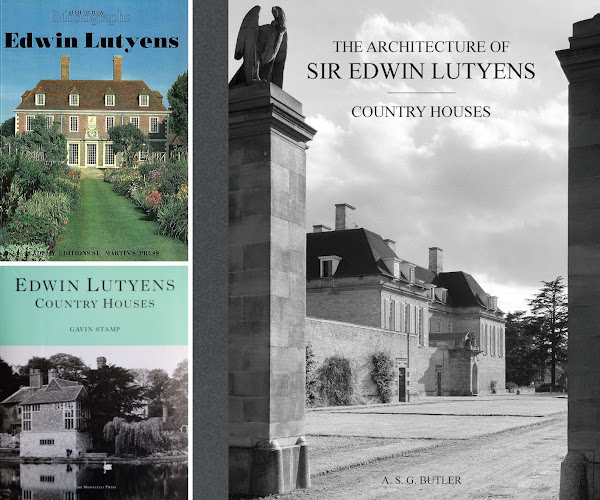
A Modernist Reads About Lutyens

Image
Sir Edwin Landseer Lutyens, the English architect who was born in 1869 and died in 1944, that is. Although a famous name, Lutyens was not an architect I had much familiarity with before I received a review copy of the first volume of  The Architecture of Sir Edwin Lutyens . Flipping through it prompted me to do a little digging on Lutyens in other publications. Racking my brain, it seems my classmates and I learned very little about him in architecture school a few decades ago. As a traditionalist with buildings in Arts and Crafts, Edwardian, and neoclassical garb, Lutyens was far removed from the concerns of postmodernism, deconstructivism, and any other –isms in vogue a half-century after his death. If we had heard his name, it was most likely in regards to what's referred to as Lutyens’ Delhi  in New Delhi, the British colonial capital in India that he laid out and designed buildings for between 1912 and 1931. The Beaux-Arts plan culminated in the Viceroy's House (now ...

From Slow House to Blue Dream

Image
Blue Dream is a house designed by Diller Scofidio + Renfro for Julia "Julie" Reyes Taubman and her husband Robert "Bobby" Taubman. The house, located in East Hampton, on the South Fork of Long Island, was completed in 2017, nearly 30 years after the architects were commissioned to design their first house on Long Island, the Slow House. A book devoted to Blue Dream, written by Paul Goldberger, was released last month by DelMonico Books. Blue Dream and the Legacy of Modernism in the Hamptons: A House by Diller Scofidio + Renfro  by Paul Goldberger, photography by Iwan Baan, published by DelMonico Books , September 2023 ( Amazon  /  Bookshop ) Like other architects educated in the United States in the early 1990s, the architecture of Elizabeth Diller and Ricardo Scofidio was an inspiration to me. Diller + Scofidio had built very little then, but their beautiful drawings and means of presenting them exhibited a clear desire to build. The only constructing the...