Posts

Book of the Moment

Image
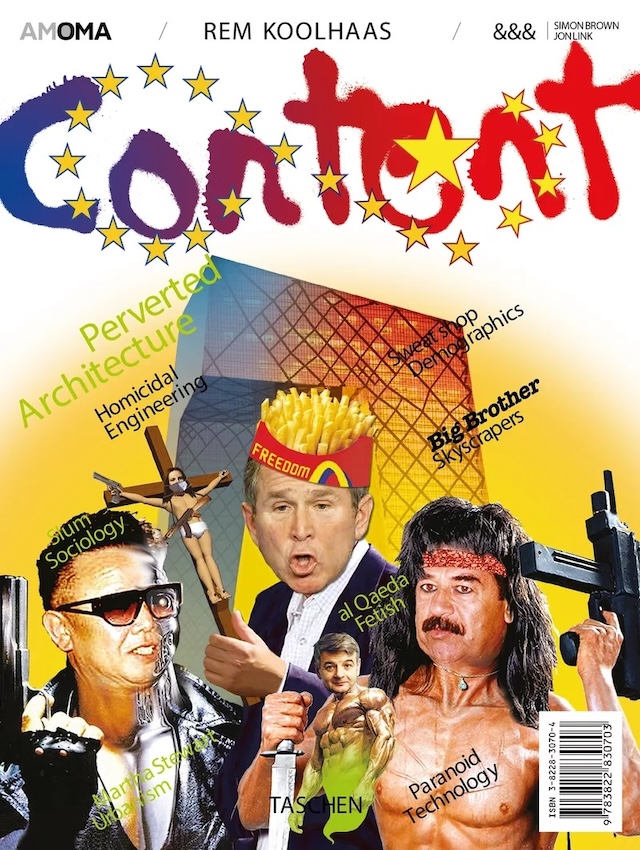
Today I received in the mail a copy of Content , a "boogazine" by Rem Koolhaas and Brendan McGetrick, published by Taschen that I first noticed at spa.uk. From the crazy cover (by Kenneth Tin-Kin Hung), to the presence of advertisements, the small format, the magazine-quality paper, the 544 super-saturated pages, the seeming lack of consistency in format, its low price,... it's an odd creature. The only continuity appears to be a red bar at the top of most pages with the words, "Go East", most likely indicating the focus of Koolhaas and OMA, as they eye more and more jobs in China. Look for a write-up on my weekly page in a few weeks.

The Credits Please

Image
My New York Times weekly film update this week included an article on film credits , or title sequences, focusing primarily on Randal Balsmeyer of New York's Big Film Design , responsible for all of Spike Lee's films, among many, many others (pdf link). Design of title sequences, introducing the actors, writer(s), director(s) and other important players, is an artform only about 50 years old, beginning with the innovative Saul Bass. My friend Jim wrote an online essay, Just the Beginning: The Art of Film Titles , which traces the evolution of main-title sequences by focusing on Bass's pioneering work for Hitchcock and the contemporary designs of Kyle Cooper for the movies Se7en and Mimic . This essay is definitely worth reading and features some clips of Bass and Cooper's credits. Chicago credits, from NYT   As the Times article mentions, sometimes credits can outshine the movie they precede. Although no specific movie comes to mind, I don't doubt this assert...

April Fool

Image
Resembling The Onion more than its usual self, the Project for Public Spaces , a non-profit group formed in 1975 to help communities improve their public spaces, released its Making Places newsletter today as Faking Places . While not as funny as The Onion , the brief articles use humor to focus on bad spaces and their causes, such as empty parking lots and Wal-Mart . Image taken from PPS For those not familiar with PPS, I would recommend looking around their site, a great resource for those interested in place making and public spaces in general. I'm particularly fond of the Great Public Spaces section, examples and case studies of parks, markets, streets and buildings that contribute to the public realm.

[Insert Soldier Field comment here]

Sunday's Chicago Tribune carried a piece by its architecture critic Blair Kamin that optimistically spoke about the city's young talents, architects that are helping to pull Chicago out of its recent funk of bland developments and neo-traditional design. I bring up the article not for its subject, but because Kamin again mentions Soldier Field, something he seems to do in every one of his pieces no matter what the topic, as my friend Frank has noted in the past. In the last paragraph of " Ones to watch " he writes, "It's also possible to forgive those in their ranks who admire such flops as Soldier Field...everyone has youthful indiscretions." Kamin lost his battle against the Mayor and the new design by Wood + Zapata, but now he seems to be using ones opinion of Soldier Field as a measure against how they're judged. Sure, these young architects are forgiven for their indiscretions, but does that mean older architects aren't? If Stanley Ti...

The Next "Starchitect"?

In a link I found at kegz.net , the Times of India reports that Brad Pitt will be taking a break from acting for an informal apprenticeship at Frank Gehry's office in Los Angeles. Recently Pitt has been involved with Gehry's efforts to revitalize downtown Los Angeles and wants to spend a year learning CAD with Gehry. Pitt's love of architecture is well known. He's quoted in a USA Today article , "[architecture] moves me like music. Done best, I can feel it moving. It has rhythms, harmonies -- it's symphonic." David Fincher , friend and director of Pitt's films Fight Club and Se7en , even boasts, "The stuff he's doing is truly great...I think in the end he may be remembered more for what he'll bring to [architecture] than what he'll bring to movies." Personally, I think it's great and I hope the news brings more attention to architecture, increasing its appeal with the public. Sure, Pitt's way of learning archite...

Book Review: Unexpected Chicagoland

Image
Unexpected Chicagoland by Camilo José Vergara and Timothy J. Samuelson, published by  The New Press, 2001. Hardcover, 208 pages. ( Amazon ) Photographer Vergara's collaboration with Chicago historian Samuelson was published in 2001, in conjunction with an exhibit at the Chicago Architecture Foundation . His focus is the overlooked pieces of cities and their changes over time, due to neglect, gentrification, politics, commercialism, etc. Sections include obvious choices like George Pullman's company town (its administration building gracing the cover) and Frank Lloyd Wright houses fallen into disrepair, but also many ordinary objects taken for granted that gain a certain meaning over time, like publi...

Square of the Patriarch

Image
Square of the Patriarch in São Paulo, Brazil by Paulo Mendes da Rocha, 1992 The Square of the Patriarch is an important place in São Paulo, Brazil. Its location makes it part of a connection between the old town and its new extension. So it seems appropriate that a project for the Square by Paulo Mendes da Rocha would be forward thinking while respecting the historical context of the city. So far, from da Rocha's designs, the mosaic pattern on the floor of the Square and a canopy covering an underground entrance to an adjacent museum have been completed. The former is a reconstruction of an existing Portugese mosaic now covering pedestrian areas for meeting and gathering. The latter is a parabolic covering , constructed like ...