Posts

On Hiatus

Image
Monday is when I would normally post a new book review, but instead, this blog and its related newsletter are going on hiatus indefinitely due to a family emergency. 

Architectural Exhibitions and Their Books

Image
Preparing for this post I counted roughly one hundred books in my library that are related to exhibitions. Surprisingly, given that I tend to buy catalogs and other companion books to exhibitions I visit, only a quarter of those hundred are exhibitions I have seen in person. Granted, a fair number of them are classics that predate my existence, such as  The International Style , the book version of MoMA's Modern Architecture: International Exhibition from 1932, or are from exhibitions that happened on the other side of the world, including two of the exhibition catalogs featured here. The fact I have so many catalogs that do not function as souvenirs to exhibitions I visited points to their enduring value: They are permanent records of temporary displays and, as such, expose the research and contents from exhibitions to considerably more people than who attended. Not all books coming out of architectural exhibitions are the same. Many of them function like art catalogs and have a ...

From the Mouths of Architects

Image
I'm not sure when it happened, but at some point I went from disliking interviews — preferring texts written by architects, much of it in the vein of theory — to gravitating to them. Now I find myself opting to read interviews, be they online or in printed matter, over other content; interviews are only below critical reviews in my rankings. I chalk up the switch to a few things: preferring the informal and clear language of interviews over the theory-/archi-speak used my too many architects; a wide prevalence of interviews, especially online; and an appreciation for them after having done a few of them myself . From the reader's perspective it may seem that interviews are easy: turn on the mic, ask some questions, transcribe the interview (or have AI software do it, more likely), lightly edit, publish. But each step of the process has its concerns, from making sure to hit "record" (yes, that happens) and having the right mic in the right location in the right room (A...

Changing Ideals in Architectural Criticism

Image
On the Duty and Power of Architectural Criticism  edited by Wilfried Wang, published by Park Books and University of Texas at Austin, 2022 ( Amazon  /  Bookshop ) Who Is the City For?: Architecture, Equity, and the Public Realm in Chicago  by Blair Kamin with photographs by Lee Bey, published by University of Chicago Press , 2022 ( Amazon  /  Bookshop ) In her contribution to On the Duty and Power of Architectural Criticism , "Critical Influence: The Influence of the Popular Architecture Critic on Architectural Decision-making," Kristen Harrison starts with a quote by Michael Sorkin: "I don't mean to trivialize either the function or the concept of criticism but — just like architecture — it must also be judged by its effects." I'll address that statement over the course of this post, but first I wanted to point out its origin. Sorkin said those words at the Architectural Association in London in February 2014, on the first day of a two-day symposium,...

On Case Studies

Image
"What is a case study?" you might be asking, or maybe, "Is it different than a monograph?" Although the word  monograph literally applies to any book devoted to any individual subject — be it a person, a place, a thing, or even an idea — in the realm of architecture books that one-word term is used more prevalently, if not strictly, in regards to individual architects and/or firms. A book on Le Corbusier is a monograph. A book on Villa Savoye is a case study. Although I opted to have two chapters in my book Buildings in Print  titled monographs — "Monographs (Architects)" and "Monographs (Buildings)" — I still prefer to call books devoted to buildings and other individual works (landscapes, artworks, books, etc.) as "case studies." I like how the phrase indicates that the subject, the case , is being analyzed in depth: it is being studied , not just presented. Ideally, a case study delves into the meaning and other aspects of a build...

For the Love of (Architecture) Books

Image
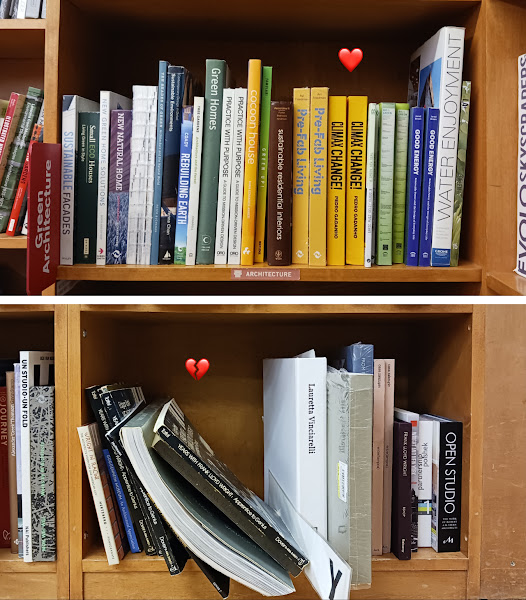
Tomorrow is Valentine's Day, so I put together a list some things I love  ❤️  about architecture books — and just as many things I don't love  💔  about them: 20 pairs in 4 categories. I can't be alone in having these opinions and I might be a bit harsh in my criticisms, but if I left something out or if you disagree with me, please comment.  Book Browsing + Buying: "18 miles of books" is a lot to keep organized. I ❤️ Browsing a well kept bookstore I 💔 Browsing an unkempt bookstore   Sometimes, as in the pair of photos above, they are one and the same. I ❤️ Finding books on Amazon – a decade ago I 💔 Finding books on Amazon – today   I'm just looking for architecture books, so no need to hit me with Prince Harry's new book on Every. Page. Of. Search. Results. I ❤️ The smell of books, be it that distinctive used bookstore scent or the whiff of a new book after peeling off its plastic wrap I 💔 Opening the envelope with that book I bought in "good...

Three Lessons from Three Monographs

Image
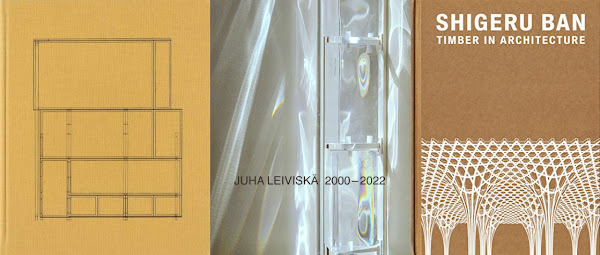
Writing a blog devoted to architecture books means featuring monographs — lots of monographs. Not exclusively, of course; but before this blog transitioned to its current weekly format, one of the thematic days of the week was appropriately devoted to monographs: Monograph Monday . Monographs are an unavoidable part of architecture books. No matter how often they are decried as passé, endangered , or even dead, monographs persevere as one of the best means of presenting a firm's built and unbuilt works  and  for marketing the same to new clients. These "uses" of monographs find their origins in books on Frank Lloyd Wright but were most influential in Le Corbusier's Oeuvre Complete , put out in eight volumes between 1929 and 1970, the last one posthumously. Though edited by others, the series of monographs were strongly controlled by Le Corbusier, which enabled a comprehensiveness many contemporary monographs forget about in their photo-heavy presentations. These three...